RYAN VAN OTTEN
Animal Hospital of Los Lunas
I was the operation and the practice manager of a 21 year-old veterinary hospital from 2011- 2015. The financial success accomplished in those three years was attributed to the development and integration of new marketing practices, protocol changes, client and staff education, and aggressive inventory management. Maintaining specific metrics, auditing inventory, streamlining billing and point of care, were paramount to the success of this business. I made the practice our first patient and made decisions that were best for the practice’s long-term health. Identifying areas of business growth potential were crucial to remaining competitive in this market.
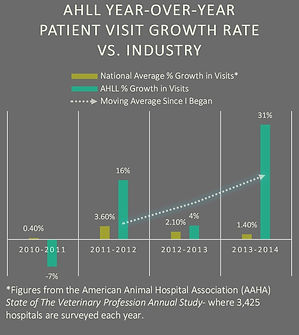
The data below demonstrates that I have been successful in growing this business, while maintaining a sustainable profit margin. (Click on graphs to enlarge).
Permission to share this information publicly, for illustrative and professional purposes, was granted by the owners of Animal Hospital of Los Lunas.


Continue reading below to see how I produced these numbers.
I recognized challenges hindering business growth and the major causes of deteriorating profits (listed below). I formulated solutions by researching the industry and by drawing from qualitative sources.


Infrastructure was lacking aesthetically, technologically, and in human capital
-
Revamped all areas and spaces of production by altering interior design, work flow, and maximizing all available space.
-
Modernized facility aesthetically for the client, but functionally for staff use.
-
Researched OSHA compliance, implemented protocol that had never existed, and developed a safety program.
-
Increased technology by improving software and budgeting for new hardware and supplies.
-
Created a new employee evaluation program and set standards and replaced ineffective staff with well-trained team members.
-
Focused on personal performance by raising internal standards.
-
Developed an internship and educational program with local vocational institute to help feed new techniques into our current system and also secure a pool in which to draw future employees.
-
Conducted weekly or bi-monthly meetings that reinforce productivity through: housecleaning, client service, and communication. Used these meetings for re-education, perfecting staff’s specific skills and to affirm the continuity in our mission as an organization.
Client relations were subpar and client retention was crucial
-
Immediately took a client’s perspective by becoming familiar with the potential consumer and the attitudes toward this industry.
-
Clearly stated our mission in a new, more comprehenisve team member handbook that focused on accountability and customer perception.
-
Revamped all operational intake forms and patient charts by constructing them as a tool to facilitate revenue growth and as an aid in providing detailed information for the client in the decision making process of services.
-
Successfully communicated value with a fair pricing strategy, which was discussed during weekly staff trainings, and expressed to clients at each level of service.
-
Explored the most convenient ways to administer services, not abiding by the previous status quo, and adjusted our protocols as necessary.
-
Pressed the notion that there is value in preventive medicine and set that as a cultural marker of our practice and with our consumer.
-
Education of clients and the community was key to compliance in patient healthcare needs, information was provided for various services.
-
All the while taking into account client’s lifestyle, expectations and overall demographics of the community we served.
-
Maintained client relations by implementing a system of dialog after each interaction, and addressing any concerns immediately.

There was a significant lack of competitive marketing
-
Introduced new marketing schemes through the use of social media and the development of a user friendly and productive webpage (ie. including an area for prescription refills, appointment requests, and service descriptions).
-
Followed trends and reduced spending on traditional yellow-page like advertisements. Redirecting funds toward tailored and individualistic marketing efforts.
-
Targeted discount offers to those clients who were well established and were more inclined to refer us.
-
Maintained efforts to inform current clients of necessary pet treatments through an aggressive mailing schedule as a reminder system.
-
Developed community outreach and improved public relations through volunteer work and by providing pet health and business information at local animal shelter and pet stores.
Markups and margins were incorrect and/or deficient, pricing strategy needed to be changed
-
Refocused on a “middle market” scheme in that things are medium-priced for medium-level service and customers have medium expectations, which can and are exceeded.
-
Researched industry specific data (including competitors), adjusting margins and pricing while still remaining competitive.
-
Constructed a fee structure in which appropriate fees are high enough to produce a respectable bottom line yet are affordable to the local residents with little to no dissatisfaction.
-
Some fees were set either too high or low in a cross-market analysis, so those were altered.
-
Specifically focused on “low hanging fruit”: laboratory tests, dentistry, flea/tick/heartworm prevention, and pet food sales (preventative medicine).
Lack of inventory management was hurting the bottom line
-
Eliminated product duplication by conducting research on varying pharmaceuticals/nutraceuticals and reviews of current veterinary literature.
-
Managed the overabundance of inventory by creating a system linked to software that aided in keeping the anticipated amount of product available at all times.
-
Used both a commonsense and research based approach to solving these issues.
-
Worked with veterinarian to find out if the products were efficacious to his form of practice and cost effective.
-
Consistently audited inventory for any squandered product and any discrepancies.
-
Monitored price fluctuations from vendors and online pharmacies- keeping generics and alternatives in stock and competitively priced.

Correcting these major problems generated a steady increase in average number of visits and transactions, enabling me to focus on more specific areas of the business. I set out to improve the departmentalized segments of hospital activities (the five main segments requiring budgetary alteration include: outpatient services, laboratory, surgery, hospitalization, boarding and grooming). I critically analyzed these areas by using available data from our sales history and by encouraging input for improvement from staff and clientele. I paid particular attention to levels of labor required in each department and averaged a comparable percent of gross income to the industry standard (38-48%). I streamlined the mode of operations within each area even further by creating more specific protocols and making adjustments to address any apparent and foreseeable issues. I also introduced new staff where needed.
I have a proven track record as an exceptional team leader and a facilitator of increased revenue. I have addressed a multitude of problems of inefficiency and was highly aggressive in solving each problem, ensuring that all changes and improvements were investments toward the overall value of the practice.